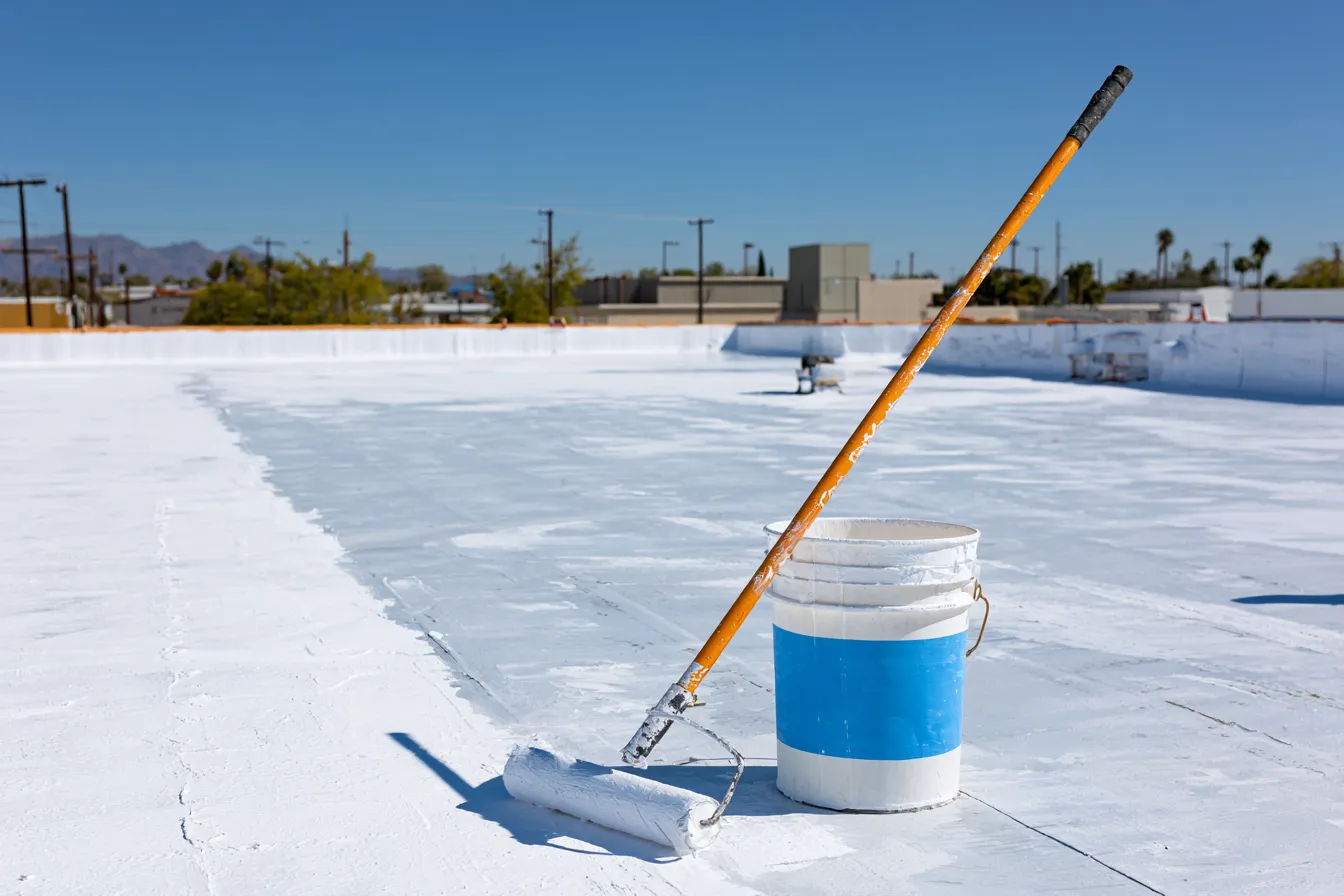
Flat Roof Repair in Alma, AR
Flat roof repair starts with the fact that a flat roof is not flat. It is built to a shallow fall, and everything depends on that fall still working.
Water that is still sitting up there a day after the rain has stopped is the roof telling you something has moved.
What flat roof repair covers in Alma
A low-slope roof sheds water by design rather than by gravity doing the work for it, and that is the difference that governs every repair on one.
A pitched roof forgives a small fault because water is leaving quickly anyway. A membrane roof holds water against the fault for hours, so a defect that would be trivial on a shingle slope becomes a leak here.
Most failures sit at the details, out at the edges of the field: seams between sheets, the upstand where the roof meets a parapet or a wall, and the flashing at drains and vents. Those are the places a membrane is joined, terminated or penetrated, which is to say the places it is not simply a continuous sheet.
The fall checked before anything else
A flat roof is built to a shallow fall. Standing water usually means that fall has stopped working.
The entry point traced from inside and out
On a low slope the stain and the opening are rarely above one another, so both sides get read.
Seams, upstands and terminations
Where the membrane meets a wall or a parapet is the hardest part of a flat roof and the first to let go.
Outlets and drains cleared and checked
A blocked outlet turns a shallow fall into a pond, and a pond finds every weakness there is.
The repair matched to the membrane
What is already there decides what can be bonded to it, and you are told when a patch buys a season and does not fix the problem.
Standing water is the first symptom
The useful signs on a low-slope roof are all about water that has not left. What follows are the cases worth acting on before the next heavy spell.
Water still there a day later
Ponding means the fall has been lost somewhere, through settlement, a sagging deck or a blocked outlet. The membrane under standing water ages faster than the rest.
Seams lifting or opening
Sheets are joined along their edges, and those joins are the first place a membrane gives up. A lifted edge is a leak waiting for the next storm.
Blisters or bubbles in the surface
Trapped moisture or air under the membrane expands in heat. Blisters do not always leak, but they mark where the bond has failed.
Staining at a wall junction inside
Where a flat roof meets a wall is the hardest detail to get right and the most common place to find water coming in.
A drain or outlet that is slow
Outlets are the whole drainage strategy on a flat roof. A slow one turns the whole surface into a shallow pond.
Surface gone chalky or brittle
A membrane that has lost its protective surface is near the end of its service life, and repairs on it will start needing repairs of their own.
Tracing a leak on an Alma low-slope roof
Finding the entry point is most of the work on a flat roof, because water travels between the membrane and the deck before it appears. The order below is how that gets narrowed down.
Where it shows inside
The interior mark is the starting reference and rarely the answer, since water runs the deck before it drops.
The details first
Seams, upstands, drains and penetrations get checked before the open field, because that is where flat roofs actually fail.
Water on suspected areas
Sections are flooded in sequence so the entry point is proven. Guessing from the stain below is how the wrong section gets opened.
The detail, then the fall
The failed seam, upstand or flashing is rebuilt, because sealant smeared over a fault is a repair with a season in it.
Flat roof questions Alma owners ask most
Trace the leak before it spreads
Where is the mark inside, and what does the roof do after rain? A local roofer traces it back to the opening instead of sealing the nearest suspect.